Wednesday, February 22, 2012

Influences for our Thriller

The main film that has influenced us is Orphan. This is because the basic storylines are very similar; we both have a little girl who has an evil side. We also intend to use this to influence our poster. We like the lighting and intend to use the same kind of tension building technique as used in the film Orphan.


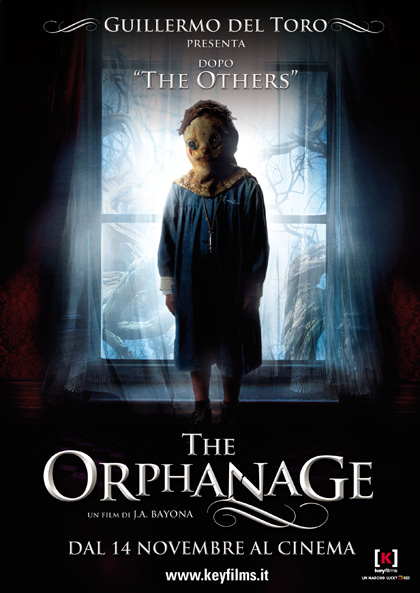
Another one of our influences for the movie is The Orphanage. This is about a child who sees ghosts and hears voices. This relates to our thriller as our girl hears voices and is a ghost herself. The difference is that in The Orphanage, the child is a boy.


The film The Others is about a family who live in an isolated house just after WW2. The two children claim to see and hear ghosts and their voices and eventually, so does their mother. They see the ghost of their father and others, eventually they find out that they are ghosts themselves. This relates to our thriller as the girl hears ghosts voices and she is a ghost herself, just like the children in this film.

The THINK 'Kill your speed or live with it' Campaign also relates to our thriller as the boy dies in a car crash, the same way that the girl dies in our film. It also shows the boy's dead body haunting the man who killed him, which the girl in our thriller wants to do. She becomes possessed and wants to go haunt the person who killed her and get revenge.

Focus Group

Q. One of your favourite thrillers:
Stephen King’s IT (1990)
Mr Cooke: “quite a lot of people don’t like clowns”
Referring back to friends garden, it is similar they can recognise a place and link it to their personal lives, linking the film into reality life, building connections, can make the film seem more believable, there for more scary and chilling. 


Hand that rocks the cradle (1992)
Mrs Lewis: “the idea of a picture perfect family then the nanny comes in and ruins everything”
Lewis feels as though she can relate to the films as she has a family herself, and some of the characters that the families portray in the films she can make connections with her family, therefore making the films have more meaning to her.


The 6th Sense (1999)
Matt Codd: “I like films with twists in them which you don’t expect”
Likes the unexpected to happen and when you don’t know what is going to happen next. It adds suspense and creates tension.     


Q. What’s your favourite type of thriller?
Mr Cooke: “you know something is going to happen and the music builds you up…..where there is an element of thinking”
Music is a key part of a thriller. The music has to be suited for what is happening on screen while also being at the right time, and building up at the right parts. Adding in sound effects can be good, however they would have to sound realistic and appropriate to what is happening and the props being used. 
Mrs Lewis: “I like the unexpected”
Not knowing what is going to happen next, but getting to know the characters and creating an opinion on them characters, which could at any moment change. Having an unexpected storyline and maybe a twist at the end or a few throughout seems to be the main points picked up from this question.
Q. Would you prefer a low subtle sound throughout or a loud sound in key moments, then no sound in others?
Mrs Lewis: “When I watch a film, I don’t like the noise”
Mr Cooke: “sometimes it seems quite false because they are trying to build it up; I think the actual suspense is built sometimes by silence” 
Matt Codd: “I like having the soundtrack at the beginning to introduce you”
From this question we gathered that sound should be used to build up a moment, but not over used as having silence and stillness will then increase the effects of the jump and scare.
Q. What do you expect from a thriller?
Mr Cooke: “Sometimes I like to have to discuss something with a friend after we’ve watched it”
Mrs Lewis: “I want it to be tense, and I want to be scared…I want it to be resolved in the end”
From this question we got some varied reviews. One of our participants liked to have a resolved thriller where all the questions were answered, whereas another one liked to have the majority answered however still a few questions which are left for you to make the decision on, this could be what happened in the future or where someone went etc.  
Q. When you first watch a thriller do you like knowing what is going to happen, or finding out as you go along, or all at once at the end?
Mrs Lewis: “Like puzzles, building up the story, giving you bits of information”
Matt Codd: “Finding out at the end”
This gave us an overview of what people want to achieve from a thriller, trying to figure out some things themselves as the ‘puzzle’ is given to you, adding more and more clues and answers to the questions raised., then finding out the story at the end.


Q. What would attract you to go see a thriller from the trailer?
Mr Cooke: “An element of mystery”
Ms Lewis: “I like references like ‘this is Barak Obama’s favourite drama”
Having celebrities commenting about the film or any product, having celebrity endorsement to promote the thriller will work very well. However as we are only 6th form media student, we cannot have celebrity endorsement, but we can recognise the potential influence that it could have over a film’s success.
Q. If a film got good reviews, would that affect if you watched it?
Matt Codd: “I look at the reviews, but I don’t really care about them…..if they relate to another film I like that”
Mr Cooke: “I wouldn’t read the reviews… see quotes on newspapers”
From this question, we realised that not many people have the time to read whole reviews, so the factor influencing them to go and see the film are based on the trailer, reviews on newspapers/magazines/TV/radio and also word of mouth (people talking about the thriller and their experience while watching- good/bad etc.) however some people will only look at the thriller and not listen to others reviews or opinions as their own can be very different, as not everyone has the same taste and we all like different styles, storylines etc.


Demographics & Psychographics

When creating a film you must define your audience and know who you are targeting it at. Demographics and Psychographics can help find a target audience for films as they can put people in to categories so it is easier to know who to aim the film at.

Demograhpics
Statistical information that can be categorized and labelled:
Sex
Age
Social Grade
Working Status
Occupation & Industry
Marital Status
Prescence of Children
Househould Tenure
Income
Education

Psychographics
How the target market feels, what they want and what is important to them:
Survivors - Those that want security and like routine
Social Climbers - Those who have strong materialistic drive and like status symbols
Care Givers - Those who believe in caring and sharing
Explorers - For people whom personal growth and influencing social change are important

Maslow's Hierarchy of Needs:
Maslow's theory was that everyone has different layers and we must satisfy one before moving on to the next. We all start at the bottom and make our way up to the top, however not everyone reaches the top and is happy settling at one of the lower layers.


Self Actualisation: The need to become what you want to become, get what you want and achieve your dreams
Esteem: Being confident, respected and admired by others.
Social: Belonging to a part of a group.
Safety: Having financial safety and a job.
Physiological: Happy to have food, a home etc.

Going to the cinema is a middle-class, social activity so we have decided to aim our thriller at 'social' people. This is because we want people in big groups to come and watch the thriller at the cinema for a night out as we believe these are the type of people who would enjoy it the most. We are aiming our thriller at both male and female, teenagers and adults as we aim to rate the film a 15. Generally our target audience is people who are unmarried, are not in the prescence of children, have a good education and a job. However this is generalised and not all of our audience will have each quality.

Tuesday, February 21, 2012

Audience Sampling

There are many types of audience sampling that can help us with research for finding out our target audience and what they like. Questions can be either closed or open.

Closed questions are when people are given multiple choice and just tick which is relevant to them. These are good questions as they are quick, easy, definate and provide quantative answers.

Open questions are when people are given space to write their answers and can write whatever they want. These questions are useful as they show people's opinions, is detailed and provides qualitive answers.

Questionnaire:
Pros:
- Other people's opinions
- Understanding of what the audience want
- Broad amount of variety of people answering
- Free if your handing it out
- Lots of ways to distribute
- Choose the questions you want to ask (can be specific)

Cons:
- Not everyone answers the questionnaire given to them
- Not everyone has the interests that our target audience have
- Irrelevant answers
- Questions can be misunderstood
- Answers may be dishonest
- Not everyone will take the questionnaire seriously

Focus Group:
Pros:
- Get reason behind answer
- Face to face conversation
- Immediate responses
- Better answers, easy to ask depth behind answer
- Bounce off of eachother

Cons:
- Similar Responses
- Can go off topic
- Time consuming
- Some may just agree and go along with other peoples answers
- One person may dominate the group
- Group may not interact well

Sampling:
Accidental Sampling is when some sort of sampling is given out to random people
Pros:
- Results represent the public

Cons:
- Irrelevant information
- People may have no interest

Volunteer Sampling:
Pros:
- Willing to answer
- Know about the topic
- Willing to think and give details

Cons:
- Same sort of people
- No variety of people or answers
- If they're your friends then they'll just say what you want to hear

Quota Sampling:
Pros:
- Ask specific people
- Your choice of who you ask

Cons:
- Answers wouldn't represent the public

We have decided to do a questionnaire and a focus group as we think these will help us know what to put in our thriller and know what our target audience like.

Why is determining a target audience important for institutions?

Institutions must know who their target audience is in order to appeal to them. People of different ages, sex, working class etc. like different sorts of films so they must be aware of their target audience in order to know what to include in the film. The company must have their target audience in mind when creating the storyline and jokes as not everything would appeal to all types of people. For example, if a family film was being made, childish jokes would be included as well as some adult humour that the children would not understand but the adults would, meaning it appeals to a wider audience.
Some institutions may try to make a film appeal to everyone even though this is impossible as not everybody likes the same thing. If this is the case then they could end up appealing to no one as they may not have had a realistic target audience.

Advertising
Institutions must be aware of their target audience so they know how to advertise the film. For example, if they were trying to appeal to a male audience then they would typically show fighting or other action scenes in the trailer as these appeal to the majority of men. Where the film is advertised is also important as the company must make sure that their target audience will see it. For example, if their target audience were teenagers then a good place to advertise would be at bus stops because many teenagers would see it as they may not be able to drive yet and will be taking public transport.

Language
Depending on the target audience, the film must have the correct type of language. The older generation would relate to proper grammar and well spoken words whereas teenagers may find this boring and prefer the characters to use more modern language and abbreviations as they will be able to relate and connect to them more.

Friday, February 10, 2012

Questionnaire

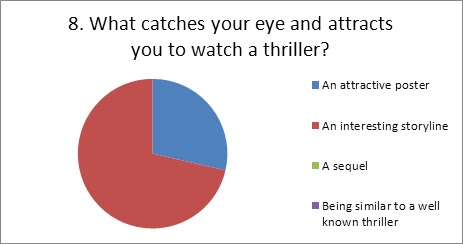
This is the questionnaire that I created in order to gather some sort of market research. I gathered the data and displayed it in bar and pie diagrams so that it was easy to see the results. We concluded that a house is the favourite location for a thriller and that fast-paced music is prefered. The best type of of thriller is a psychological thriller and most people expect thrillers to be awarded a 15 certificate. An interesting storyline that involves mystery was voted the best theme for a thriller.
This has helped us to further decide what we will base our thriller on and how to go about filming and editing it.


Tuesday, February 7, 2012

BBFC Ratings

BBFC stands for British Board of Film Classification. Every film must be given a rating by BBFC in order for the audience to know what to expect and whether they can view the flm. We researched the BBFC ratings for films and looked at what content each rating allows in the film. We decided we will aim to make our thriller a 15. Once we have created our thriller we will look back at these ratings and see which one is suitable for it.